🔎 Mobility budget and cafeteria plan: what is allowed and what is not?

Founder of MMBB & MBE | Mobility Budget Expert
April 20, 2026
🔎 Mobility budget and cafeteria plan: what is allowed and what is not?
Recently, Nahima Lanjri (CD&V) asked a parliamentary question about a striking practice: the combination of the mobility budget with a cafeteria plan .
Why is this relevant?
Because some accumulations do not comply with both the spirit and the letter of the law.
⚠️ Where does the problem lie in practice?
Situation 1
An employee exchanges his car for the mobility budget.
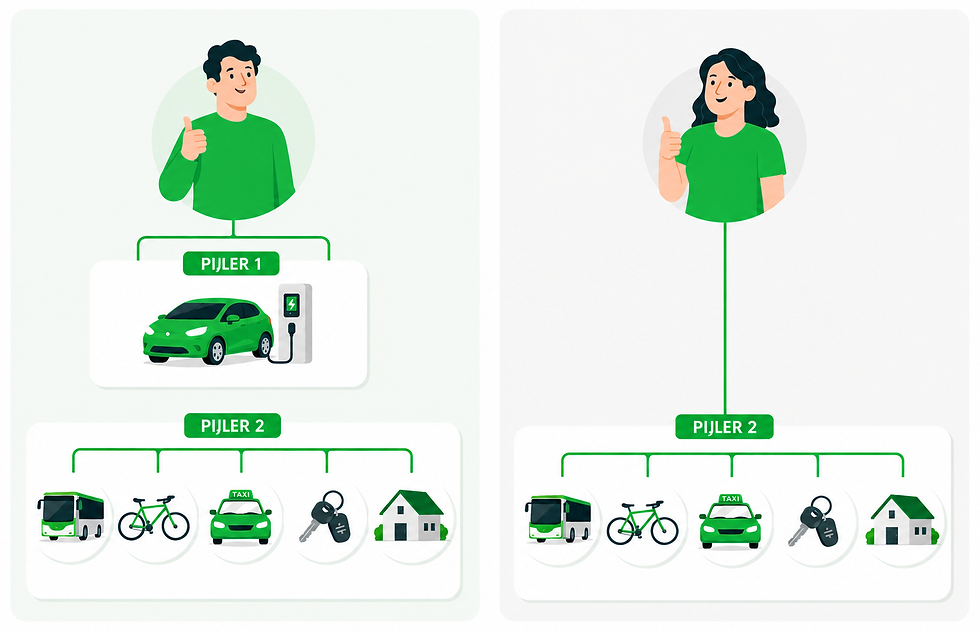
He does not choose a car in pillar 1 and spends everything in pillars 2 and 3.
But via the cafeteria plan he chooses a (more polluting) company car after all.
➡️ According to the official answer, in that case, the mobility budget must be discontinued from the month in which the employee has a car at their disposal again.
Situation 2
An employee does choose an environmentally friendly car in Pillar 1.
But through the cafeteria plan, he finances:
an upgrade of that car
or, for example, a charging station
➡️ This is also problematic.
Why?
Because the mobility budget is strictly limited by law (Art. 12 Law of 17.03.2019).
When the budget is insufficient:
the employee must repay the difference
or must the difference be considered as wages and be subject to social security contributions and taxes
The law therefore does not permit cumulation whereby one would obtain the same social and fiscal benefits on top of the mobility budget via a cafeteria plan.
After all, that would amount to an additional benefit that is inconsistent with the principles of the law.
📜 What is the government saying clearly?
The mobility budget is subject to specific social and tax treatment .
If the legal limits are exceeded, it loses that preferential treatment.
The combination with a cafeteria plan must not result in a higher total cost than the employee is entitled to within the statutory range.
🎯 Conclusion
The mobility budget is not a freely combinable benefit.
The boundaries are legally defined and strict.
Combining a cafeteria plan is only possible as long as:
✔ the legal maximums continue to be respected
✔ no additional preferential tax regime arises
✔ the employee does not again have a company car at their disposal outside of Pillar 1
Otherwise, the preferential regime lapses.
As is so often the case with the mobility budget: The technical details make the difference.


Comments