The bicycle and the Mobility Budget
March 3, 2026

The bicycle and the Mobility Budget
Company bicycles are enjoying increasing popularity. Many companies already offer a company bicycle, sometimes in combination with a company car, for example through a cafeteria plan. When the bicycle is used for commuting, the company bicycle benefits from favorable tax and social security treatment.
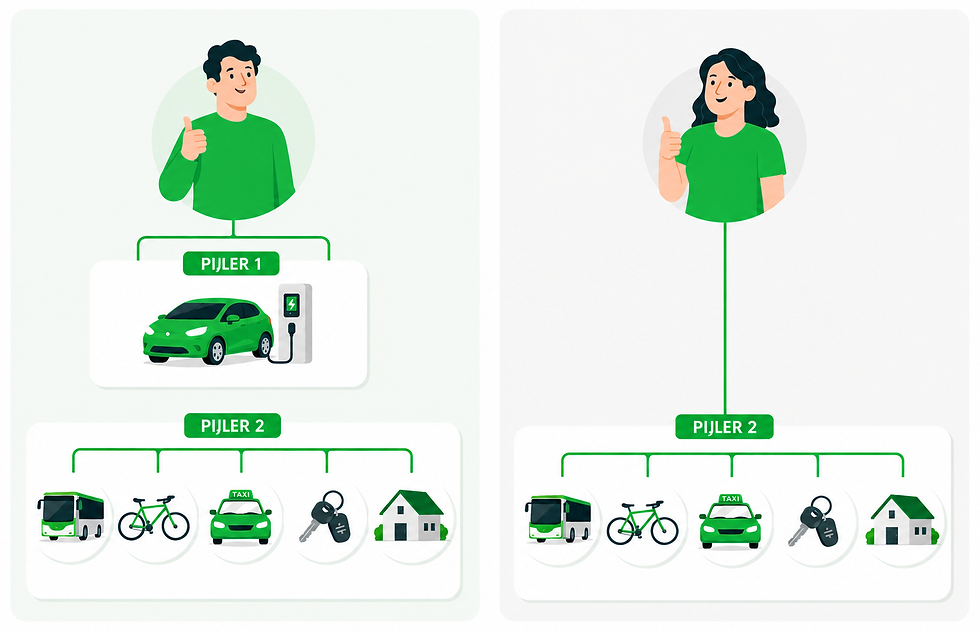
Within the framework of the Mobility Budget, this falls under sustainable mobility, as provided for in Pillar 2 of the legislation regarding the Mobility Budget. Many companies therefore wonder: How can the company bicycle be correctly integrated within the framework of the Mobility Budget?
1. Hypothesis 1 – The employer does not yet offer a company bicycle
In the absence of a structured bicycle offer by the employer, the employee can use their Mobility Budget to purchase, rent, or finance a bicycle.
Purchase
The employee can purchase a bicycle themselves with their Mobility Budget.
Please note: the employee can only use the maximum amount of their Mobility Budget for the year in which the purchase takes place.
Financing or leasing
The employee can also opt for private financing or private leasing, allowing the monthly costs to be spread over several years. This financing is arranged through the bank chosen by the employee or by the bicycle dealer, if the latter offers such formulas.
In both cases, the employee:
can acquire one or more bicycles, including all associated options;
has complete freedom in the choice of options;
not required to commit to using the bicycle regularly for commuting, but can receive a mileage allowance paid from his Mobility Budget if he does so;
enjoy an exemption from personal income tax and social contributions for everything falling under Pillar 2 (and therefore also the bicycle).
2. Hypothesis 2 – The employer already offers a company bicycle
Whether this is done via a cafeteria plan or an internal company scheme, the company bicycle can easily be integrated into Pillar 2 of the Mobility Budget.
However, if the company bicycle was granted more than three months prior to the introduction of the Mobility Budget (together with the company car), the employer may also choose to continue offering the company bicycle outside the mobility budget.
However, the government's intention is to simplify complex taxation and incorporate all mobility-related matters into the mobility budget. Experts are therefore of the opinion that company bicycles should best be included in the Mobility Budget.
That same “3-month rule” also applies to all tax benefits associated with commuting, such as bicycle allowance and reimbursement of public transport.
The company bicycle does not exclude hypothesis 1, a personal (additional) private bicycle; it complements the options within Pillar 2 of the Mobility Budget.
In the case of a company bicycle:
can the bicycle purchased by the employer be depreciated or spread over several years;
in practice, the employer often opts for a bicycle leasing formula where full financing and solvency guarantees are provided by the employer;
Does this concern a tax benefit? The bicycle is not taxed if the employee commits to regularly commuting by bicycle.
3. TCO and bicycle: essential clarification
The costs associated with the company bicycle cannot be added to the TCO.
After all, the TCO (Total Cost of Ownership) corresponds exclusively to the total cost of the company car that is replaced by the Mobility Budget.
The bicycle constitutes an expenditure within the Mobility Budget (pillar 2), but does not change the reference TCO.
4. Creating a cycling culture
The Mobility Budget therefore offers an opportunity to encourage cycling among your employees. You focus on a cycling culture by starting with the question:
· Why do you, as an organization, want more people cycling?
· Do you want to promote employee health, reduce parking costs, focus on sustainable corporate social responsibility or employer branding…?
Next, you examine how employees travel today and what needs or barriers they experience. Based on this, you create a concrete action plan.
That plan combines certain preconditions, such as theft-proof and comfortable bicycle parking, charging points for e-bikes, lockers, and possibly showers, with measures that make cycling attractive, such as a bicycle allowance, awareness campaigns, and incentives. Moreover, offering a company bicycle is a very accessible way to get employees on a high-quality bike.
Also consider potential risks in advance, such as those related to road safety, and anticipate them through appropriate measures.
Finally: communicate regularly and lead by example as management. This way, cycling will gradually grow into a permanent part of the company culture.
www.mbe.be for more information and assistance
Authors
Delphine Eeckhout
Thierry Devresse
Bart Vanham


Comments