Why Choose a Mobility Budget Without Pillar 1?

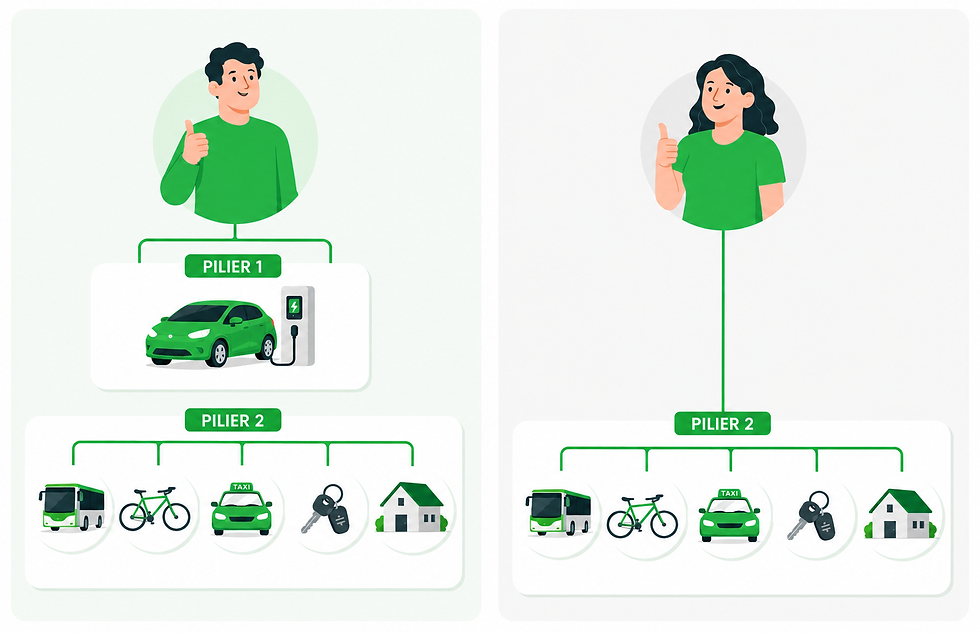
How to Choose Between a Mobility Budget With or Without Pillar 1
When implementing a Mobility Budget, one of the most important decisions is whether or not to open Pillar 1. Pillar 1 allows employees to include a company car within their Mobility Budget.
There is no universally correct answer. Both approaches have advantages and drawbacks. The right choice depends mainly on the company's objectives, the profile of its employees, and the level of flexibility it wishes to offer.
Understanding What Pillar 1 Really Is
First and foremost, it is important to understand that the Mobility Budget is a choice offered to employees. It does not replace the traditional company car and does not remove any existing rights.
The system simply introduces an alternative: a Mobility Budget within which the employee may choose to include a company car that is less expensive than the company car they would normally be entitled to. This vehicle is referred to as the Pillar 1 company car.
If the employee does not wish to opt for a less expensive company car, they can simply retain their traditional company car outside the Mobility Budget.
When Is Pillar 1 Used?
Pillar 1 is only used when two conditions are met. The Mobility Budget beneficiary must:
Wish to retain a company car;
Be interested in reducing the cost of that company car in order to free up part of the budget for other mobility solutions such as public transport, one or more bicycles, taxi services, a rental car during holidays, housing costs, and similar expenses.
Market experience shows that fewer than 10% of Mobility Budget users actually choose Pillar 1.
When these conditions are not met, employees generally opt for one of the following solutions:
A traditional company car without a Mobility Budget;
A Mobility Budget without Pillar 1, with or without a privately owned vehicle.
Why Choose a Mobility Budget With Pillar 1?
1. Offering a Complete Mobility Menu for All Employees
Including Pillar 1 allows employees to decide for themselves how much of their Mobility Budget they wish to allocate to a company car and how much they wish to spend on other mobility solutions.
The broader the range of options, the more flexible the system becomes. This flexibility generally leads to greater acceptance and adoption of the Mobility Budget within the organization.
2. Supporting the Ecological Transition
All vehicles currently offered under Pillar 1 are fully electric.
By contrast, when employees purchase a vehicle with their own private funds, they may still choose a vehicle with an internal combustion engine.
Opening Pillar 1 can therefore contribute to accelerating the transition toward cleaner vehicles and help organizations achieve their environmental objectives.
3. A Simple and Easy-to-Understand Concept
For many employees, the principle is straightforward:
"I have a budget and I choose how to spend it."
This approach is often easier to understand and accept than:
"I have a budget, but certain options are excluded."
4. Getting It Right from the Start
Experience shows that many organizations that initially choose to close Pillar 1 eventually decide to open it one or two years later in response to employee demand.
Opening Pillar 1 from the outset can therefore help avoid a future revision of the mobility policy.
Why Choose a Mobility Budget Without Pillar 1?
1. Simplifying the Implementation of the Mobility Budget
Defining the rules and conditions for Pillar 1 is ideally done with the support of an experienced consultant.
By keeping Pillar 1 closed, an organization can typically save between one and two working days during the implementation phase of the Mobility Budget.
2. Simpler Vehicle Administration
Pillar 1 vehicles are subject to specific legal requirements that can be more restrictive than those applicable to traditional company cars.
While some of these challenges can be addressed pragmatically in practice, not all organizations are comfortable with such an approach and may prefer a strict interpretation of the legislation.
3. Avoiding the Creation of an Additional Vehicle Category
In some organizations, employees already benefit from the lowest-cost vehicle category available in the company car policy.
Keeping Pillar 1 closed avoids the need to create an additional entry-level vehicle category and helps keep the existing car policy simple.
4. Waiting for Future Legislative Changes
It is likely that future amendments to the Mobility Budget legislation will simplify certain Pillar 1 requirements.
Some organizations therefore prefer to wait until these changes take effect before opening Pillar 1.
Conclusion
Pillar 1 does not replace the traditional company car and is only relevant to a minority of Mobility Budget beneficiaries.
Choosing a Mobility Budget with Pillar 1 provides employees with greater flexibility and freedom of choice while supporting the electrification of the vehicle fleet.
Choosing a Mobility Budget without Pillar 1 simplifies the implementation and administration of the system, which may be a significant advantage for certain organizations.
The right choice therefore depends primarily on the company's objectives, its level of mobility maturity, and the degree of flexibility it wishes to offer its employees.


Comments